skip to main | skip to sidebar
Consumers Relocation Services

Wednesday, April 19, 2023

Preparing your houseplants for moving

From recent Bekins Van Lines Blog


How to Pack Your Houseplants for a Move

First thing’s first: if you can, transport your plants with you in your own vehicle—don’t ship them. Oftentimes, if you ship them, they won’t receive enough airflow, water or sunlight.

What You Need to Get Started

To set yourself up for success as you pack your plants, make sure you have these items on hand:

  • A sturdy moving box for each pot (small boxes are best so the plant doesn’t move around too much)
  • Plastic pots to replace clay pots during transit
  • Sterilized potting soil
  • Packing paper or newspaper
  • Bubble wrap
  • Plastic bags and ties
  • Paper towels
  • Flea collars

How to Prep Your Plants for the Big Day

Houseplants are living and sensitive; they will need time to adjust to the transition. Start prepping your plants approximately three weeks before moving day. To prep your plants, take these steps:

  • To make your plants easier to carry, repot them into plastic, lightweight pots with sterilized soil.
  • Prune the plants a week before moving day. Remove dying pieces and cut back additional foliage, for example.
  • About three days before moving day, water your plants.
  • Unfortunately, houseplants often harbor pests that states won’t want you bringing across state lines. Put a flea collar around each pot to draw any critters out. If you live in an area with the , there are more steps you’ll have to look into.

How to Pack Your Potted Plants

Step One:

Put a plastic bag over the plant and pot and tie it at the bottom. This is done to keep the soil in the pot.

Step Two:

Put the plant in a box. Make sure the box is taped on the bottom to keep the plant secure.

Step Three:

Fill any extra space in the box with newspaper.

Step Four:

Allow for airflow by putting holes in the box.

Step Five:

Label the box as “plant.” This is especially important if you’re getting help from friends, family, or a moving company so they know to be extra careful with that particular box.

If you need help with packing or transporting your belongings to your new home, get in touch with the expert movers at Bekins today! We can get you and your family to your new home smoothly and quickly.

Posted by Consumers Relocation Services at 7:13 AM 3 comments:
Email ThisBlogThis!Share to XShare to FacebookShare to Pinterest

Tuesday, April 11, 2023

Getting ready for your vehicle to be shipped

Taking some simple steps to prepare your vehicle for shipment will help make your experience smooth and trouble free.  


A couple things to remember.  

You will get a call from the driver the day before pick up and delivery to set up the time for pick up/delivery. Sometimes this carrier will call you early the morning of pick up if they are located near you.  The trucks are large car carriers and may not be able to get close to your house safely.  If this is the case the driver will arrange with you to meet at a location where the truck may be loaded or unloaded safely.  At origin and destination the driver will inspect your car for any damage and note the bill of lading.  You will be asked to sign off on this on the bill of lading.  Please be sure to review and agree or comment on any notations made on the bill of lading with regard to the vehicle's condition, and note any discrepancies or changes at destination.  This will be the basis for a claim if necessary.

You should have alternate arrangements for a contact if you plan not to be at either location.  It is your responsibility to be or have someone be present if the truck arrives early or is delayed.

Please have no more than 1/4 tank of gas in your car
Please remove all ski and bike racks
You will need to supply the driver a full set of keys that work to start your vehicle and lock/unlock it.  
Please remove any electronic toll devices so that they are not charged going across the US
Please remove all personal items from the inside of the car.  You may put things in the trunk of up to 100 lb total with some carriers or below the window level in the way back if there is not trunk.

If you need to put lots of items in your vehicle please be sure to get this cleared with the carrier ahead of time.  If they allow extra items you will most likely be charged extra.  You will not really know how much until the driver arrives and assess' the amount of things in the vehicle. 

Posted by Consumers Relocation Services at 12:25 PM 1 comment:
Email ThisBlogThis!Share to XShare to FacebookShare to Pinterest

Thursday, April 6, 2023

Real Life Move with a dishonest Moving Broker- still no delivery of the shipment


The Story

I got a call from a friend's friend today who was desparate for help.   He contacted a company he thought was A Major Van Lines; same colors and similar logo.  Well guess what- they were not!  A broker who charges a large deposit up front and a large amount when picked up.  A warning sign.  They based their estimate on cubic feet of space on a truck rather than weight which can be audited.   The delivery window was anytime during a 30 window after pick up.


They provided a price which was attractive to the customer and he scheduled the pick up. They charged 1/3 of the estimate at booking, 1/3 at pick up and  the balance at delivery.  The move was assigned to a mover, for pick up and delivery named HM (abreviated).  Since pick up it is now 30 days and no delivery, just demands for more money.  The price has gone up from $3800 to over $6000 based on the company's claim the cubic feet went up.  Neither the mover nor the broker are calling their customer back and he has no idea where his belongings are. 

The warning signs...

Large deposits paid to the broker in several payments. Large deposit due carrier at pick up.  The legitimate Van Lines agents may charge a deposit but it is paid to the mover itself not to a broker. It is usually a couple hundred dollars if charged at all.  

Estimate based on cubic feet not weight.  There is no way of auditing the size of the actual move using cubic foot measurments.  When weight is used by a legitimate mover/van line; weight tickes are required from a certified weigh station before the household goods are loaded on the truck and after resulting in the net weight of  the shipment. 

No specific delivery spread- in this case the customer was told delivery sometime in a 30 day period for a relatively short distance- Oregon to Arizona.  Vanlines will provide a specific delivery spread in dates and will pay a penalty to the customer for late delivery. 

Unlimited amount of money due to deliver the household goods.  Most Van lines will limit the amount due to unload the shipment, then a balance due afterward.

No visual survey or video survey by the mover it self.  Estimate not written on the movers document or Order for Service


Types of terms to watch out for:

The carrier reserves the right to collect up to 50% of the balance due prior to the goods leaving the origin state. Subject to federal law, payment in full of all charges is required before delivery and prior to unloading.

Upon pickup carrier, will collect up to 50% of the remaining balance

Should the customer’s estimate come in under the predicted cubic feet, XXXXX Broker will refund 50% of the customer’s price for cubic feet up to 1000 cubic feet. It is the shipper’s responsibility to pursue the carrier if they are looking for additional reimbursement beyond 50% of the price per cubic foot.

The carrier who is responsible for picking up and delivering the household goods of the customer has up to 30 business days to deliver the household goods of the customer

First available delivery dates (FADD) are not guaranteed delivery dates. The first available date is the 1st date you are ready and willing to accept your delivery. The carrier has 30 business days from the FADD you choose to deliver the household goods


If you see any of these warning signs or feel uncomfortable that you may be getting into an uncertain agreement to move your belongings- call your Moving Consultant at Consumers Relocation before you sign.  

Posted by Consumers Relocation Services at 2:35 PM No comments:
Email ThisBlogThis!Share to XShare to FacebookShare to Pinterest

Friday, March 31, 2023

Shipping a vehicle? Rates starting to creep up!

 Shipping a vehicle and have some flexibility in timing?  Then now might be a good time to do it.  We are seeing rates inching up, and expect a big jump in vehicle shipping rates by May.  June and on during the summer is definitely the peak in rates for shipments. 

Image result for auto shipping pictures 

Consumers Relocation ships hundreds of  vehicles each year and only uses the best carriers and providers.  You can feel confident that your vehicle is in safe hands, with no surprises in rates or services.  All carriers are fully insured.  Our network or carriers covers the entire USA and we ship internationally as well. 

Call us for a quote. 802-824-3496


Posted by Consumers Relocation Services at 2:57 PM No comments:
Email ThisBlogThis!Share to XShare to FacebookShare to Pinterest

Monday, March 13, 2023

Interest rate hikes by the Fed effects Household Goods shipments!

 Interest rate hikes over the past months intended to slow inflation has cerntainly put a damper on the relocation business!


During the first quarter of this year Van Lines are reporting significant reduction in business over past years.   This has resulted in some cases loss of drivers who are already in short supply in the industry.  

What this means for those planning to relocate during the traditionally busy spring and summer months is perhaps a shortage of trucks/drivers available for moves, and desired move dates being unavailable with some Van Lines.  

People desparate to move may scramble to find solutions which may not be in their best interest.

Consumers Relocation offers customers a safe alternative since we work with multiple reputable, world class van lines and local agents to ship household goods.  Call us and ask to speak wtih a moving Consultant 


Posted by Consumers Relocation Services at 11:07 AM No comments:
Email ThisBlogThis!Share to XShare to FacebookShare to Pinterest

Monday, April 11, 2022

Why plan ahead for your move! 6 Good Reasons Why

6 Reasons To Start Planning Your Move As Early As Possible

April 11, 2022 by Nina Smith

Relocating is a part of life, and every one of us switches households at least three times in our lives. This is a tolling process, both emotionally and physically, and you want to help yourself make the right choices when the day comes. Because of that, you need to start making the schedule on time, and here, we are going to list some of the reasons why you need to start planning your move as early as possible.

1. You will be able to evaluate items

The most important rule of every move is that you need to decide which things you want to keep, which items should be donated, what can you sell and make some cash, and what things should be just thrown away.

When you need to pack in just a week or two, there is no way for you to do it, and chances are, you’ll end up keeping things you never use, and you’ll throw away items that you are going to need. So, instead of rushing, and doing everything on the last day, you should give yourself time.

Start going through every room, and make separate piles of things. Find places where you can donate your goods, and don’t forget to have a yard sale to make some money.

2. You won’t have to rush

Source: spacer.com.au

When we rush, we end up breaking things, and in the middle of the process, we start throwing things away that can be useful or can be donated. This is the part when we just want to get rid of as many items as we can because we realize how many things we actually own.

On the same note, when we are near the end of the packing, we just start giving up on separating things, and we end up being clumsy, we tend to break or damage a lot of our possessions, and when we just have a small portion of goods left, we decide that we need to pack all of that, we just throw things in boxes and hope that we can get them sorted out later down the line.

When you have a lot of time to move, and when you can plan things in advance, you won’t have to rush through this process, and you can take all the time you need to make decisions.

3. You can book the service you want

If you need to move, chances are, you cannot do it on your own, especially if you are moving across the country. Because of this, you will need a trustworthy and reliable service to help you out. More often than not, these companies are booked far in advance, and the ones that are left last minute may not be as careful or as reliable as you would need them to be.

If you don’t want to end up having to go with just any service, it is best to start planning and researching at least a few months before the move. You should see which companies are available for you, and what services they provide.

For more information on storage and moving services, and how they can make a difference for your relocation, check out https://m25group.co.uk/.

4. You won’t feel stressed

Source: kidsinthehouse.com

Stress is our biggest enemy, and everyone who has ever moved from one place to another knows how difficult this can be. You need to face the fact that you are moving away from the people you love, the habit you have, and the place where you have made so many memories. Relocation is always good and it makes room for new and better things, but that does not mean that we won’t feel sad about the things that we leave behind.

In these emotional moments, the last thing that you need is to have to worry about technicalities, and when you do it at the last minute, you will definitely add to the stress you are already feeling. So, instead of dealing with anger, being upset, and instead of getting headaches over all the small things, you should start planning your move as early as possible.

5. You will have time to clean

We all know that we are not going to just leave our home looking like a wreck, and no matter if you were planning to sell it, rent it, or if you are leaving a place that you used to rent, you will need to do some cleaning. It is hard to pack and clean at the same time, and having to do it last minute means that you are not going to do a good job.

More often than not, people who plan to move in the last week end up calling cleaning services, and that will add an additional financial toll on you. If you want to save yourself some cash, and if you don’t want to rush to do everything, then it is far better to start planning now and do things one step at a time.

6. You will avoid making mistakes

Source: ssrelocation.com

It is said that during the moving process, everyone is bound to make mistakes. This is all normal, and there are going to be things that you forget, items that you throw away, and you will even break an item or two. Once again, this is all expected, but you can easily minimize all the mistakes that you make if you start planning on time.

When you have the luxury of time, and when you can do proper research, you will avoid mistakes and you will be able to do it all within your budget. Starting from selecting the right boxes and bags for the move, up to researching and booking services, you can do it all properly and you won’t have to pay thousands of dollars extra for everything.

Have these things on your mind when you think you have months until the move, and remember that the earlier you start planning, the better it is going to be for you. You will have time to adjust to the fact that you are relocating, and you will be able to make the right choices. Know that there are always services that can help you out with the process, and you don’t have to do it all on your own.

Categories Life, Tips Tags Early Planning, Moving Process, Planning Move, Reasons
Post navigation
6 Simple Things You Can do to Improve Your Music Listening Experience
How To Protect Your Wooden Floor From Heavy Furniture


Posted by Consumers Relocation Services at 5:53 AM No comments:
Email ThisBlogThis!Share to XShare to FacebookShare to Pinterest

Tuesday, January 11, 2022

How omicron will affect the housing market

 What follows is an interesting take on how this new variant will effect the housing marketing in 2022.   This excerpt was taken from an article published on Realtor.com® written by By Janet Siroto

Jan 5, 2022.


Before the omicron variant of COVID-19 appeared on the scene, the 2021 housing market was rebounding healthily from previous waves of the pandemic and turned downright bullish as the end of the year approached. In spring 2021, a Realtor.com® survey found that only 10% of homeowners planned to sell within 12 months. By fall, that number had ballooned to 26%.

These factors had portended a tidal wave of home sales in the new year. And then the new omicron strain hit in November, followed by a December dip in new listings.

Was this sudden drop due to omicron, or just the typical holiday season lull?

George Ratiu, manager of economic research at Realtor.com, isn’t sure, but feels optimistic that omicron won’t halt the housing market’s momentum, particularly since this variant appears milder than its predecessors.

“We are not through it yet, but so far, this virus seems to be a lot more contagious, but also a lot less negatively impactful in terms of sickness and death,” Ratiu says. He also points out that data from epidemics in 1918 and the 1950s have also shown that viruses become more contagious but less severe over time.

Indeed, indications from South Africa, where the COVID-19 strain was first detected, showed a steep surge in cases followed by a rapid decline. So there’s some reason to expect that this latest wave of the pandemic in the U.S. will follow suit.

Omicron doesn’t seem to have hit the economy as hard as previous waves, either.

“The GDP and economy have survived fairly well,” Ratiu explains. “We’re seeing housing weather the variant so far. Retail sales, consumer confidence, and other indicators show guarded optimism in the road ahead.”

Bottom line: Even as COVID-19 infection rates climb, most experts aren’t bracing for a shutdown like we saw during the first wave of the pandemic in spring 2020.

“I do not believe that omicron will have much impact on the selling season,” says Cara Berkeley, a personal financial expert at Penny Polly. “The delta variant did not seem to slow things down here [in Tennessee], so omicron should not either. The number of homes sold in Nashville in November of this year was higher than the number sold in November of last year. The upwards trend both in sales and in the median price per home is continuing.”

Posted by Consumers Relocation Services at 8:22 AM 1 comment:
Email ThisBlogThis!Share to XShare to FacebookShare to Pinterest

Tuesday, November 23, 2021

Americans didn’t move nearly as much as you may’ve thought during the pandemic - Could have fooled me!!

Americans didn’t move nearly as much as you may’ve thought during the pandemic

Amanda Peacher Nov 18, 2021
Heard on:
Listen Now
New Census data show surprisingly low relocation rates over the pandemic. Above, a mover places boxes in a moving truck in New York City. Michael M. Santiago via Getty Images

Over the past year and a half, Marketplace has talked about how people have relocated during the pandemic — say from big cities to little mountain towns, or upgrading from a small house to a more “work-from-home-friendly” house.

New Census data actually show that relocations were down this past year. In 2021, Americans actually moved at the lowest documented rate in over 70 years.

Now, a lot of Americans did move around during this past year and a half. But whether or not someone picks up and moves has a lot to do with access to resources.

That pandemic narrative of urban residents escaping and then driving up home prices in rural Vermont or Central Idaho? It’s not like that’s false.

“It’s possible to hold two truths in our minds at the same time,” said Rachel Franklin, a professor of geographical analysis at Newcastle University in the United Kingdom. “People did flee cities, but it was temporary or reflects maybe a more sort of dynamic lifestyle where people move back and forth.”

Marketplace
Hosted by Kai Ryssdal

What Franklin is talking about here is not migration but mobility. People may not be picking up and moving permanently; some are buying vacation homes or working remotely from the beach for a couple of months.

“And it’s also in sort of a socio-economic niche,” she said. “This is not the way most people have experienced the pandemic for sure.”

It’s not how Roberto Echanique, who lives near Washington D.C., has experienced it.

“Must be nice to have that flexibility,” he said.


Echanique and his partner have thought about moving. “You know, greener pastures, a little more space, a little less crowded,” he said. “For what we make, there’s no way we could afford anything at all, within, you know, one or 200 miles of here.”

If you think about the kinds of big life events that often prompt moves — say, going away to college, getting married, starting a new in-person job — a lot of those things have been on hold for the past two years.

“A lot of them were not happening anymore,” said John Logan, a sociology professor at Brown University.

Americans, in general, are moving less than they were say fifty years ago, Logan said. Still in the past decade, a third of Americans, at the least, moved neighborhoods.

“That’s characteristic of the United States. So we’re not a pioneer society with a frontier anymore,” Logan said.

But compared to other countries, Logan said we’re still a pretty mobile society.

Posted by Consumers Relocation Services at 12:35 PM No comments:
Email ThisBlogThis!Share to XShare to FacebookShare to Pinterest

Thursday, November 18, 2021

An Ultimate Guide for Moving Interstate with Pets!

A great article from the California News Times 11/17/21

jackmartin1 day ago
An Ultimate Guide for Moving Interstate with Pets!

Moving isn’t an easy task to perform with ease. Instead, moving is one of the most hectic jobs that impact physical and mental state a lot worse. However, adding your pets into it can make the job more critical for sure. This isn’t only for you and your family members, even moving can be stressful enough for your pets too.

So, while moving interstate with your pets, it is necessary to have proper planning. Failing to make a proper plan can make you a real worried during your move. However, being a caring person, it is solely your responsibility to take care of your pets during the move.

However, if you’re a bit worried about your upcoming move with your pets, we are here to guide you. This article genuinely describes the ways so that you can have a stress-free relocation with your pets. Let’s dig in!

Consulting with Your Vet is Essential

Once you have tried letting your pets know about the recent relocation, it is essential to consult with your vet. Your vet can help a lot in the moving process if you’re moving with your pets. As already stated that your pets can be emotionally down during the moving process. So, you must perform a thorough health check-up before commencing the move. If there are any health hazards arise in any circumstances, your vet can eliminate the risks associated with this before you commence the move. Your pets are just like your kids. So, taking risks won’t be a wise decision for sure.

Do You Have Vaccination Certificates of Your Pets?

The best out of state movers in the network of Moving Feedback explain that it is crucial to have the vaccination certificate for your pets. Checking all the vaccination details of your pets is essential in any situation while you’re moving with your pets. It won’t be a wise decision to travel with your pets without vaccinating them properly. Getting an authentic health certificate of your pets will eliminate several difficulties during the move for sure.

However, ignoring these things will not only be a threat to your pets, but you can also face several legal complications during the move as well. Especially if you’re moving with dogs or cats, having authentic rabies vaccinated tag is essential for getting an entry to the new state.

Break the News to Your Pets

Well, you may be wondering that how you can let your pets know about the upcoming relocation! How they will understand about the recent relocation that is going to take place!

However, you might be surprised to know that several studies showed that pets could feel and read the minds of humans. So, while you’re planning for a move, try to let them know about the fact beforehand. If they can even feel a bit of the upcoming activities, it would help them to cooperate with the moving process.

Do You Have Travel Identification Tags of Your Pets?

Only having vaccination certificates for your pets isn’t enough if you’re moving interstate. In addition to the vaccination certificates, you need to have authentic identification tags of your pets as well. The identification tags must have the name of the pets, the name and address of their parents, and an alternate person’s details.

The details of an alternate person are mostly mandatory for travelling with pets in the USA. In any circumstance, if the pet owner can’t be located, the authority will contact the alternate person to hand over the pets.

Transporting Pets Have Restrictions 

Well, you might not know that transporting your pets to another state has some restrictions. You can’t relocate your pets in a moving truck. The pets aren’t the household items that you can move through a moving truck. However, there are a couple of ways with which you can relocate your pets securely.

By Air

One of the best ways to relocate your pets is by air. Of course, you can’t relocate them in trains, buses, or even in a hired moving truck. However, you can relocate them by air for sure. In such scenarios, you can either move with them or consider an appropriate container for moving them to the new destination.

In the Personal Motor Vehicle

However, if you don’t wish to relocate them by air, you can consider moving them in your vehicle. Moving them in a personal motor vehicle is always best for your pets. They are already habituated to travel in your vehicle. So, if you choose to relocate them in your vehicle, it will eventually help your pets get emotionally strong during the move.

Conclusion

So, we hope that you’re now better ready to move your pets to the new destination. However, if you still have any doubts to clear, you can ask in the comment section. We will try answering them for sure.

Additionally, if you have any suggestions regarding moving with the pets, let us know in the comment section. Finally, wish you all the best for your upcoming move with your loving pets!


Posted by Consumers Relocation Services at 11:06 AM 1 comment:
Email ThisBlogThis!Share to XShare to FacebookShare to Pinterest

Wednesday, June 16, 2021

Families should expect moving delays this summer as companies recover from COVID

 This article was published specifically about Military families moving, but it applies to all families moving this summer.  We all use the same logistics, moving companies, van lines and mover employees to accomplish all moves.  

_________________________________________________________

After a rocky year moving to new orders during the COVID-19 pandemic, the Air Force is warning its troops that supply shortages could make transitions difficult this summer too.

April to September tend to be peak moving months around the nation, but after coronavirus forced many civilian and military families to put off transitioning to their new homes, moving companies were forced to downsize. Now the demand is overwhelming what the moving industry can handle in its smaller state.

“Department of Defense demand this peak permanent change (PCS) of station season has greatly exceeded commercial industry capabilities, largely due to resource constraints associated with the COVID-19 pandemic,” an Air Force Personal Property Activity Headquarters memo states. “Per industry, this resulted in a 25% decrease in their labor pool, resulting in decreased personal property movement capacity necessary to support private sector and government demand.”

This summer has the potential to be one of the biggest moving seasons for military families since many had to defer their PCSs due to COVID.

    .

DoD put restrictions on who could travel or access bases at the beginning of the pandemic. It eventually settled on a color-coded system to dictate which installations were cleared for travel.

Now 90% of bases are in the “green” zone, meaning that service members can move to new orders or visit bases without any special authorization. The number hovered in the 40% to 65% range for a large part of 2020.

Katie McMichael, director of moving and storage conference at the American Trucking Associations, told Federal News Network, this summer is that “perfect storm” for moving demand.

“COVID obviously hit everyone hard,” she said. “The commercial market slowed down during COVID, but it has come roaring back. You are seeing it in the relocation trends, people are moving with the changing way people are working now.”

McMichael added that third party freight services were affected by COVID and not as many are available to ship goods.

To mitigate the impact, the Air Force Joint Personal Property Shipping Offices say they are employing all available tools and options to accommodate shipment and delivery requests. DoD services and U.S. Transportation Command are working with commercial industry to modify business rules and add flexibility to achieve maximum carrier capacity.

McMichael said those efforts are extremely helpful, but there is not a magic solution.

The Air Force said there are some actions airmen can take to add more flexibility and ease the burden of moving:

        Read more: Defense

  • Get shipping requests in four to six weeks prior to the pickup window.
  • Ask about expanding pack/pickup (a.k.a., “spread date”) windows from the current seven-day requirement to 14 days.
  • Contact the assignments team to determine if they can postpone the move by changing the report-not-later-than date.

Airmen also have the option of “do-it-yourself” moves. DoD now offers 100% reimbursement of costs plus a fuel surcharge and other accessory costs.

“In addition to the old “rent a truck” option, airmen now have access to new modes within the commercial industry called portable moving and storage containers,” authors of an Air Force release wrote. “These containers are dropped at the home, the service member packs them and the company picks up, transports, stores and then delivers at the destination. Some companies also offer a menu of associated services including full or partial packing.”

Scott Maucione

Scott Maucione is a defense reporter for Federal News Network and reports on human capital, workforce and the Defense Department at-large.

Follow @smaucioneWFED

Posted by Consumers Relocation Services at 11:30 AM 4 comments:
Email ThisBlogThis!Share to XShare to FacebookShare to Pinterest

Tuesday, March 16, 2021

Safe Moving Options During Uncertain Times

Moving during the COVID-19 pandemic? Moving can be stressful even during normal times, moving during a pandemic can be even more stressful. Fortunately, the moving industry has adapted, and best business practices altered for the safety of everyone. Whether your move is small or large, there are options for your move. 


Posted by Consumers Relocation Services at 1:29 PM 2 comments:
Email ThisBlogThis!Share to XShare to FacebookShare to Pinterest

Thursday, January 7, 2021

So many people headed to Florida- here are some reasons why

 Miami South Beach, Fla.


Photographer: Marco Bello/Bloomberg
What You Need to Know About Relocating to Florida
Jan. 7, 2021, 4:01 AM

The combination of warm weather and no personal income tax makes Florida a desirable place to relocate. Connie Eckerle of Smolin outlines what you need to keep in mind to make a clean break from your current domicile—and its taxes.

White sand beaches and tax incentives have people turning to the Sunshine State. And not just the traditional retirees—remote workers nowhere near retirement are also considering making the move. Because if you have to socially distance yourself, you might as well have balmy winters to keep you company, right?

But why Florida?

As appealing as warm afternoons on the beach sound with winter here, there are things to consider when it comes to relocating to Florida. What do you need to know before buying a plane ticket?
The Siren Song of Tax Incentives

Many states across the country are currently operating at a deficit and the loss of income taxpayers to greener pastures, so to speak, is driving an increase in those state’s residency audits. By and large, rules haven’t changed but states are getting more aggressive and fewer exceptions may be made than in the past.

Florida is one of the few U.S. states with no state income tax, so it’s no surprise that people from the high-income tax states are among the top relocators. The Tax Cuts and Jobs Act (TCJA) has left some people looking to improve their tax position.

Before the TCJA, individuals in higher-taxed states were able to benefit from State and Local Tax (SALT) deductions on federal income tax forms. But now the TCJA limits the SALT deductions to $10,000 annually. SALT deductions have historically represented big tax breaks for individuals who itemized their Schedule A deductions. For those in high-income tax and property tax states, this has been a big hit.

But to see these tax benefits, one has to officially change their state of residence. For those planning on splitting time between Florida and their previous state, there are a few important factors to weigh—and a few things to watch for.
Where is Your Domicile?

When making the move to Florida, your goal is to establish Florida as your domicile, or your permanent home. The “facts and circumstances” behind your move to Florida plays a key factor when proving that you’re a Florida resident in the event of a state residency audit.

Although you may own more than one home, you only have one domicile. What does that mean? It’s the place a person calls home and intends to reside indefinitely—and whenever the person leaves that home, where he or she intends to return.

Because establishing domicile can be ambiguous at times, states may take a hard look at several factors. They consider the size and nature of use of your home, where is your time spent, your business involvement, your personal connections, and location of items “near and dear” to you.

There are also some additional ways to document your domicile in Florida including filing a declaration of domicile at your county office, obtaining a Florida driver’s license, registering to vote in Florida, and several others.

Moreover, domicile is impacted by your reasons for moving. But domicile is only one piece of the puzzle. Statutory residency may need to be considered.
There’s No Place Like Your Statutory Residency

The nomadic lifestyle is increasingly common. In the U.S., 4.8 million independent workersdescribe themselves as digital nomads according to a report by MBO Partners. Yet if you’re bouncing back and forth between locations, you may risk having the status of “statutory resident” bestowed on you.

Definitions of “statutory resident” vary from state to state. Some states consider you a statutory resident, at least for tax purposes, if you spend more than half the year or 183 days in the state. Some states lack specific rules, but consider someone a resident if the state considers them to be there for more than temporary reasons.

And that statutory residency status could very well come knocking with an unexpected tax bill in hand. More specifically, it can mean being taxed on all your income, including capital gains, dividends, and interest income.

How do you avoid being classed as a statutory resident? Know the rules of your state and follow them carefully.
Real Estate, Estate Tax, and Other Factors to Consider

Establishing a domicile in Florida and establishing residency is a complicated process. Ideally, you can make a clean break by selling all real estate, moving all business activities, and fully investing in your life in Florida by buying a home in Florida. This is the best way to indicate intent to make Florida your domicile.

Along those lines, be cautious of how you handle any real estate sales you may initiate — you want to take advantage of the capital gains exclusion on the sale of your primary residence. To do this, the home you are selling must have been your primary residence for two of the last five years. For example, if you’re selling your New York residence in year five of claiming Florida residency, you would not be able to take the capital gain exclusion since the New York residence would have been your primary residence for only one year in the last five years.

If you choose instead to maintain multiple properties between Florida and another state, you’ll want to keep detailed records of financial transactions and travel plans to document where you have been in the event you are audited by the state.

You’ll also want to consider estate taxes when you’re considering relocation to Florida, especially if you are at or near retirement age. Florida, as you may know, doesn’t have an estate tax, but your current state may. It’s important to update your estate plan to reflect Florida’s laws upon establishing domicile in Florida.

Relocating to Florida may sound dreamy—white sand beaches and tax breaks are a great combination. However, it takes some careful planning and strategy to avoid an unexpected tax bill. Consulting with an experienced tax professional is a helpful step before making any plans.

This column does not necessarily reflect the opinion of The Bureau of National Affairs, Inc. or its owners.
Author Information

Connie Eckerle is a member of the Smolin Lupin and a licensed Certified Public Accountant in Florida and Georgia.


Posted by Consumers Relocation Services at 5:29 AM No comments:
Email ThisBlogThis!Share to XShare to FacebookShare to Pinterest

Thursday, August 6, 2020

Research Current Covid Travel restrictions before leave for your destination

 Daily, states are changing their travel restrictions for people entering their states to prevent the spread of Covid 19.  You need to understand what those restrictions are before you leave your current home state to relocate to a new one.  

These restrictions are getting tougher as the spread of Covid widens.  Here is but one example of how strict the regulations are getting.

BOSTON (AP) — Travelers to Massachusetts, including residents returning home after out-of-state trips, face $500-per-day fines if they refuse to comply with a new executive order requiring them to quarantine for 14 days to control the spread of the coronavirus, Gov. Charlie Baker announced Friday.

The order that takes effect Aug. 1 comes at the height of the summer tourist season and not long before tens of thousands of college students typically flock to the state for the start of fall classes.

There are exemptions for people coming from low-risk states, which currently include New York, New Jersey, Maine and Hawaii, and for people who can prove they have had a negative COVID-19 test no more than 72 hours prior to arriving in Massachusetts, the Republican governor said at a news conference.

ADVERTISEMENT


Posted by Consumers Relocation Services at 12:55 PM 1 comment:
Email ThisBlogThis!Share to XShare to FacebookShare to Pinterest

Tuesday, July 7, 2020

Many People Moving due to Covid 19


About a fifth of U.S. adults moved due to COVID-19 or know someone who did

Roughly one-in-five Americans either have relocated due to pandemic or know someone who has

←
Posted by Consumers Relocation Services at 9:17 AM 2 comments:
Email ThisBlogThis!Share to XShare to FacebookShare to Pinterest

Friday, March 27, 2020

Planning To Move April 1? You Still Can Under Illinois’ Stay At Home Order

A good article in Planning To Move April 1? You Still Can Under Illinois’ Stay At Home Order

Moving and relocation services is considered a "critical trade."
Published on Mar 24, 2020 1:05PM CDT
Logan Square, Humboldt Park, Avondale Primary category in which blog post is published
Mina Bloom
@mina_bloom_

Logan Square, Humboldt Park & Avondale reporter mina@blockclubchi.org   


CHICAGO — Those planning to move April 1 with the help of movers shouldn’t have any problems doing so under Illinois’ stay at home order.

Moving and relocation services is considered a “critical trade,” along with janitorial work, painting and HVAC work and other services that “are necessary to maintaining the safety, sanitation, and essential operations of residences, essential activities, and essential businesses and operations,” according to Gov. JB Pritzker’s order.

The order calls for Illinois residents who don’t work at essential businesses to stay home through April 7 to stop the spread of the new coronavirus. Read the full order here.

RELATED: Here’s What’s Open And What’s Closed Under Stay At Home Order To Curb Coronavirus Outbreak

That date could be extended, though, officials have warned.

“I’m not going to tell you I know the end of April 7, that this is, in fact, the end date. We believe that that gives us time to see whether or not this social distancing and this stay at home is having the desired effect of bending the curve,” Prtizker said when announcing the order.

Anyone who leaves their home, including people who are moving and movers, is urged to practice social distancing.

Illinois had 1,285 confirmed cases of COVID-19 and 12 deaths as of Tuesday afternoon.
Symptoms

Coronavirus can be deadly, but the vast majority of cases have been mild. Those most at risk from the virus are people who are elderly or who have underlying health conditions.

Symptoms of coronavirus can appear two to 14 days after a person has been exposed to the virus, according to the Centers for Disease Control. People with no symptoms may have the virus and spread it to others.

The virus spreads between people through coughing and sneezing, according to the Illinois Department of Public Health.

The most common symptoms:

    Fever
    Cough
    Shortness of breath

People have also experienced body aches, nasal congestion, runny nose and sore throat, according to Harvard Medical School.

If you or someone else has difficulty breathing, persistent pain or pressure in the chest, become confused, cannot be roused or develop a bluish face or lips, get immediate medical attention, according to the CDC.
How To Protect Yourself

The CDC only recommends those are already sick wear facemasks because they help you avoid spreading the virus.

Here’s what you can actually do to prevent getting ill:

    The CDC and other officials have said people should wash their hands often, including before, during and after eating; after using the bathroom; and after blowing your nose, coughing or sneezing.
    The CDC has a guide here for how to properly wash your hands. Remember: Wash with soap and water, scrubbing your hands for at least 20 seconds.
    If you can’t wash your hands with soap and water, you can use an alcohol-based hand sanitizer, according to the Illinois Department of Public Health.
    Avoid touching your face, especially your eyes, nose and mouth, with unwashed hands.
    Clean and disinfect objects and surfaces you touch frequently, like cellphones and light switches. Here are tips from the CDC.
    Stay home when you’re sick and avoid close contact with people who are sick.
    If you have to sneeze or cough with a tissue, throw it out immediately after using it, according to the CDC.

What To Do If You Think You’re Sick

Even if you’re not showing symptoms, the Chicago Department of Public Health recommends people coming from high-risk countries (here’s a CDC list) self-quarantine for 14 days after returning home.

If you do have symptoms of coronavirus, contact your primary doctor or a health care facility before going in. Explain your symptoms and tell them if you’ve come into close contact with anyone with coronavirus or traveled to an area where COVID-19 is widespread (here’s a CDC list) within the last 14 days, according to the Illinois Department of Public Health.

From there, the experts will work with your local health department to determine what to do and if you need to be tested for coronavirus, according to the Illinois Department of Public Health.

And, of course, if you think you’re sick with coronavirus, don’t risk exposing other people to the virus. Anyone who feels unwell has been ordered to stay home or risk getting a $500 fine.

Those with questions and concerns about coronavirus can call the Illinois Department of Public Health at 800-889-3931.

Block Club Chicago’s coronavirus coverage is free for all readers. Block Club is an independent, 501(c)(3), journalist-run newsroom.

Subscribe to Block Club Chicago. Every dime we make funds reporting from Chicago’s neighborhoods.


Posted by Consumers Relocation Services at 6:04 AM 3 comments:
Email ThisBlogThis!Share to XShare to FacebookShare to Pinterest

Tuesday, March 24, 2020

Covid-19 Update 3/24/20

"Stay at home advice" is so important to everyone to beat the Coronavirus.  A number of states have enacted this advice, and have told all business' but "essential business'" to close until April.  Moving and Relocation support services have been deemed "essential business'" and therefore most companies in this industry remain open to assist our moving and relocating clients and customers. Consumers Relocation, our Van Line partners, and most of their local agents are open for the time being.  All of us are following all the CDC guidelines, and staffing in our offices only essential employees who can not work remotely.

At Consumers Relocation, we are supporting our employees, and have all discussed and agreed on what essential employees should continue to work in the office, and which employees should work remotely.  We have taken measures to keep as few employees in the office as possible to reinforce social distancing and have others working remotely.

We will keep you updated as things develop.


Posted by Consumers Relocation Services at 2:49 PM No comments:
Email ThisBlogThis!Share to XShare to FacebookShare to Pinterest

Wednesday, March 18, 2020

Update Covid-19 and CRS operations

These are unprecedented times and changes are coming quickly.  Consumers Relocation takes this Coronavirus outbreak very seriously, and yet we understand our customers needs to continue with their plans to move and relocate.  We remain open while taking serious steps to protect our customer's and our employee's health.  Our commitment to our customers continues and we are taking all the steps necessary to march on in that regard.

We have as many of our staff working remotely as possible at this time and  have increased the space between those who need to occupy the office on as limited a basis as possible.  We are taking all recommended steps within our office building, a dedicated building only to Consumers Relocation, to distance employees and keep our work space clean and virus free.  Our business operates entirely on the phone and electronically so visitors and customers do not come in physical contact with our employees.  

All of our Van Line partners have made arrangements as well to either work off site or follow strict CDC guidelines.  Their crews and drivers have specific instructions on how to carry out their jobs in customers' homes following strict guidelines to prevent the spread of the virus.  We are including, with every new initiated order to our partners, suggested guidelines for cleanliness, reducing the number of people in a customer's home to a minimum, non use of any facilities in the customer's home, and use of sanitizer frequently.  We also are encouraging video surveys rather than in home surveys of  household goods eliminating the need for a surveyor to enter the home to provide an estimate.  

We hope that all of our clients, customers, employees and van line partners stay safe during this uncertain time.   We will keep everyone updated on any changes through our web page and access to our blog from our web page.  

Thank you for your trust in us.   Our relationships with our clients, customers and van line partners are vitally important to us and your safety is paramount .

Les Velte
Consumers Relocation Services
Posted by Consumers Relocation Services at 8:36 AM No comments:
Email ThisBlogThis!Share to XShare to FacebookShare to Pinterest

Friday, March 13, 2020

Special instructions to Drivers, crews and salesmen of our van line partners

Special instructions during the  COVID-19 (Coronavirus) outbreak

During this difficult time, we are asking our van line partners on every referral we sent out and every booking notification to take these simple but special measures when serving our customers. 

Instructions to our Van Line Partners
moving household goods necessitates some contact between drivers, customers and crews. This is unavoidable. Here are some suggestions:
  • Providing staff, crews and drivers with plenty of hand sanitizer to be used regularly in between hand washing
  • Minimizing the presence of crews in customers’ homes when individuals are not specifically working
  • Whenever possible, minimizing the use of restrooms inside customers’ homes
  • Using hand sanitizer in front of customers so they understand we are taking everyone’s health and safety seriously
  • Encourage video surveys for estimates when practical.
Posted by Consumers Relocation Services at 8:57 AM 2 comments:
Email ThisBlogThis!Share to XShare to FacebookShare to Pinterest

Wednesday, March 4, 2020

Remote Work enables employees to move to more affordable locations

In a recent study by Redfin, working remotely provides employees an opportunity to move to locations they want to live in or to more affordable ones. 

March 2, 2020 - By Lily Katz

For 25% of Americans, telecommuting increases after a move.

With unemployment at the lowest level in decades and wages stagnant, the chance to telecommute is allowing U.S. workers to move to more affordable areas, while maintaining their salaries. Of those who do move to a new metro area, 1 in 4 work remotely more frequently after relocating, according to a new survey conducted by Redfin.
“The job market is very tight and employers want to hold on to people, so companies are much more willing now to allow workers to move,” said Redfin chief economist Daryl Fairweather. “Plus, technology has enabled employers to let staff work remotely in a cost-efficient and productive manner.”
Of all eligible survey respondents, more than half (51.1%) work remotely sometimes or always after their move, compared with just 44% who worked remotely before the move.

One way employers may be battling salary increases and supporting retention is by offering employees the ability to work remotely instead of higher wages, Fairweather said. For employees, the chance to work remotely allows them to move to a more affordable place while maintaining their salary.
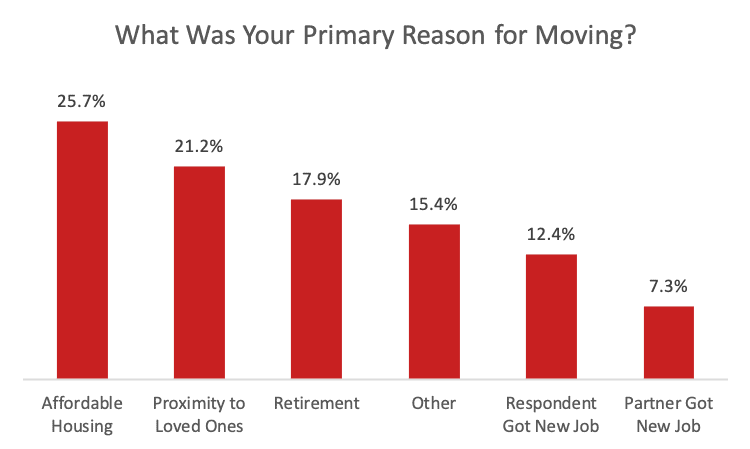
Survey respondents listed varying reasons for packing up their lives. The most common primary justification was more affordable housing (25.7%). In second place came proximity to family/partners (21.2%), followed by retirement (17.9%).

While only a quarter of participants move for affordability, almost 60% said their ability to afford non-housing expenses and leisure activities improved after their relocation.
About 1 in 7 respondents said they wouldn’t have been able to move without the ability to work remotely. Of people who moved specifically for affordability reasons, a slightly higher share said they couldn’t have relocated without remote work, indicating that remote work has enabled workers to move to areas with more affordable homes.
The most common metros respondents migrated away from for affordability reasons were the Bay Area, Los Angeles, and Seattle, while the most popular metros people moved to for affordability were Phoenix, Sacramento, CA and Portland, OR.
In the fourth quarter of 2019, 26% of Redfin.com home searchers looked to move to another metro area, up from 25% during the same period of the prior year, according to a Redfin report from February. That tied the all-time high for the national share of home-searchers looking to relocate that was set in the third quarter of 2019. Phoenix, Sacramento and Las Vegas saw the highest net inflows.
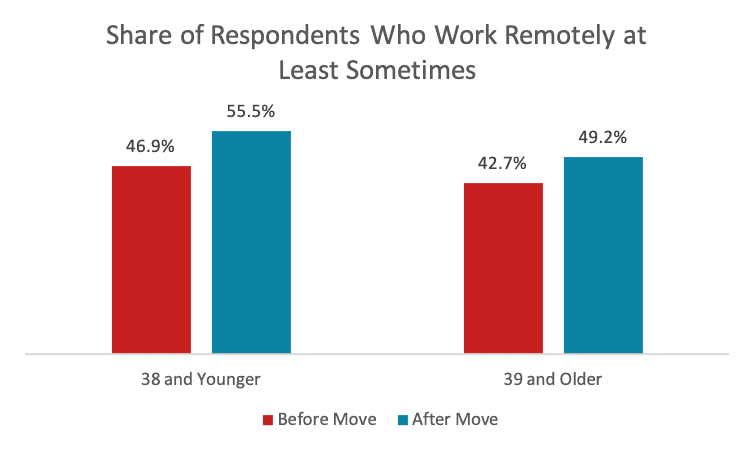
Among the survey respondents, younger people saw a greater increase in remote work after relocating than older people. Of participants 38 and younger, 55.5% worked remotely sometimes or always after moving, up from 46.9% before moving. Of participants 39 and older, 49.2% worked remotely sometimes or always after moving, compared with 42.7% before moving.

Methodology

Redfin conducted a survey in December 2019 of 272 U.S. residents who indicated that they either moved to a new metro area within the past year or have plans to do so within the next year. All respondents were asked about why they moved, where they moved to and from and how remote work played into their relocation. About 75% of people surveyed resided in Los Angeles, San Francisco, New York, Seattle or Boston.
For more information about the survey and its findings, contact press@redfin.com.

Posted by Consumers Relocation Services at 11:44 AM 1 comment:
Email ThisBlogThis!Share to XShare to FacebookShare to Pinterest
Newer Posts Older Posts Home
Subscribe to: Posts (Atom)

Search This Blog

eNewsletter

Click here to view our monthly enewsletter filled with more helpful moving tips!

About Me

My photo
Consumers Relocation Services
View my complete profile

Get a Quote

Fill out our initiation form and we will contact you right away with up to 3 quotes.

Les Velte Twitter Updates

Twitter Updates

    follow me on Twitter

    Blog Archive

    • ▼  2023 (5)
      • ▼  April (3)
        • Preparing your houseplants for moving
        • Getting ready for your vehicle to be shipped
        • Real Life Move with a dishonest Moving Broker- sti...
      • ►  March (2)
    • ►  2022 (2)
      • ►  April (1)
      • ►  January (1)
    • ►  2021 (5)
      • ►  November (2)
      • ►  June (1)
      • ►  March (1)
      • ►  January (1)
    • ►  2020 (11)
      • ►  August (1)
      • ►  July (1)
      • ►  March (5)
      • ►  February (3)
      • ►  January (1)
    • ►  2019 (16)
      • ►  September (1)
      • ►  July (1)
      • ►  June (3)
      • ►  May (2)
      • ►  April (2)
      • ►  March (4)
      • ►  February (3)
    • ►  2018 (7)
      • ►  May (1)
      • ►  April (4)
      • ►  March (2)
    • ►  2016 (5)
      • ►  September (1)
      • ►  August (1)
      • ►  May (1)
      • ►  March (1)
      • ►  February (1)
    • ►  2015 (8)
      • ►  November (1)
      • ►  October (1)
      • ►  July (1)
      • ►  June (3)
      • ►  May (2)
    • ►  2014 (12)
      • ►  December (1)
      • ►  November (1)
      • ►  August (1)
      • ►  July (2)
      • ►  June (1)
      • ►  April (2)
      • ►  March (2)
      • ►  February (2)
    • ►  2013 (16)
      • ►  June (2)
      • ►  May (1)
      • ►  April (4)
      • ►  March (1)
      • ►  February (3)
      • ►  January (5)
    • ►  2012 (23)
      • ►  November (1)
      • ►  September (2)
      • ►  August (1)
      • ►  July (1)
      • ►  June (7)
      • ►  May (1)
      • ►  April (4)
      • ►  March (3)
      • ►  February (2)
      • ►  January (1)
    • ►  2011 (47)
      • ►  December (1)
      • ►  November (4)
      • ►  October (4)
      • ►  September (7)
      • ►  August (3)
      • ►  July (4)
      • ►  June (4)
      • ►  May (4)
      • ►  April (4)
      • ►  March (8)
      • ►  February (1)
      • ►  January (3)
    • ►  2010 (112)
      • ►  December (4)
      • ►  November (7)
      • ►  October (12)
      • ►  September (5)
      • ►  August (4)
      • ►  July (6)
      • ►  June (8)
      • ►  May (9)
      • ►  April (15)
      • ►  March (12)
      • ►  February (13)
      • ►  January (17)
    • ►  2009 (47)
      • ►  December (7)
      • ►  November (5)
      • ►  October (3)
      • ►  September (5)
      • ►  August (7)
      • ►  July (5)
      • ►  June (13)
      • ►  May (2)

    OnTopList

    Real-estate blogs
    Add blog to our blog directory. Consumers Relocation Services - OnToplist.com

    Blog Flux

    Blog Directory by Blog Flux

    TOPBLOGLIST

    Top Blogs

    TOPBLOGLIST

    Real Estate

    Blog Carnival

    Blog Carnival archive - moving and relocation information

    Blog Top Sites

    Real Estate Blogs

    BC

    Real Estate Investment & Advice Blogs - BlogCatalog Blog Directory
     

    Twenty Fives Years!

    Twenty Fives Years!

    Subscribe To

    Posts
    Atom
    Posts
    All Comments
    Atom
    All Comments