skip to main | skip to sidebar
Consumers Relocation Services

Tuesday, July 7, 2020

Many People Moving due to Covid 19


About a fifth of U.S. adults moved due to COVID-19 or know someone who did

Roughly one-in-five Americans either have relocated due to pandemic or know someone who has

←
Posted by Consumers Relocation Services at 9:17 AM 2 comments:
Email ThisBlogThis!Share to XShare to FacebookShare to Pinterest

Friday, March 27, 2020

Planning To Move April 1? You Still Can Under Illinois’ Stay At Home Order

A good article in Planning To Move April 1? You Still Can Under Illinois’ Stay At Home Order

Moving and relocation services is considered a "critical trade."
Published on Mar 24, 2020 1:05PM CDT
Logan Square, Humboldt Park, Avondale Primary category in which blog post is published
Mina Bloom
@mina_bloom_

Logan Square, Humboldt Park & Avondale reporter mina@blockclubchi.org   


CHICAGO — Those planning to move April 1 with the help of movers shouldn’t have any problems doing so under Illinois’ stay at home order.

Moving and relocation services is considered a “critical trade,” along with janitorial work, painting and HVAC work and other services that “are necessary to maintaining the safety, sanitation, and essential operations of residences, essential activities, and essential businesses and operations,” according to Gov. JB Pritzker’s order.

The order calls for Illinois residents who don’t work at essential businesses to stay home through April 7 to stop the spread of the new coronavirus. Read the full order here.

RELATED: Here’s What’s Open And What’s Closed Under Stay At Home Order To Curb Coronavirus Outbreak

That date could be extended, though, officials have warned.

“I’m not going to tell you I know the end of April 7, that this is, in fact, the end date. We believe that that gives us time to see whether or not this social distancing and this stay at home is having the desired effect of bending the curve,” Prtizker said when announcing the order.

Anyone who leaves their home, including people who are moving and movers, is urged to practice social distancing.

Illinois had 1,285 confirmed cases of COVID-19 and 12 deaths as of Tuesday afternoon.
Symptoms

Coronavirus can be deadly, but the vast majority of cases have been mild. Those most at risk from the virus are people who are elderly or who have underlying health conditions.

Symptoms of coronavirus can appear two to 14 days after a person has been exposed to the virus, according to the Centers for Disease Control. People with no symptoms may have the virus and spread it to others.

The virus spreads between people through coughing and sneezing, according to the Illinois Department of Public Health.

The most common symptoms:

    Fever
    Cough
    Shortness of breath

People have also experienced body aches, nasal congestion, runny nose and sore throat, according to Harvard Medical School.

If you or someone else has difficulty breathing, persistent pain or pressure in the chest, become confused, cannot be roused or develop a bluish face or lips, get immediate medical attention, according to the CDC.
How To Protect Yourself

The CDC only recommends those are already sick wear facemasks because they help you avoid spreading the virus.

Here’s what you can actually do to prevent getting ill:

    The CDC and other officials have said people should wash their hands often, including before, during and after eating; after using the bathroom; and after blowing your nose, coughing or sneezing.
    The CDC has a guide here for how to properly wash your hands. Remember: Wash with soap and water, scrubbing your hands for at least 20 seconds.
    If you can’t wash your hands with soap and water, you can use an alcohol-based hand sanitizer, according to the Illinois Department of Public Health.
    Avoid touching your face, especially your eyes, nose and mouth, with unwashed hands.
    Clean and disinfect objects and surfaces you touch frequently, like cellphones and light switches. Here are tips from the CDC.
    Stay home when you’re sick and avoid close contact with people who are sick.
    If you have to sneeze or cough with a tissue, throw it out immediately after using it, according to the CDC.

What To Do If You Think You’re Sick

Even if you’re not showing symptoms, the Chicago Department of Public Health recommends people coming from high-risk countries (here’s a CDC list) self-quarantine for 14 days after returning home.

If you do have symptoms of coronavirus, contact your primary doctor or a health care facility before going in. Explain your symptoms and tell them if you’ve come into close contact with anyone with coronavirus or traveled to an area where COVID-19 is widespread (here’s a CDC list) within the last 14 days, according to the Illinois Department of Public Health.

From there, the experts will work with your local health department to determine what to do and if you need to be tested for coronavirus, according to the Illinois Department of Public Health.

And, of course, if you think you’re sick with coronavirus, don’t risk exposing other people to the virus. Anyone who feels unwell has been ordered to stay home or risk getting a $500 fine.

Those with questions and concerns about coronavirus can call the Illinois Department of Public Health at 800-889-3931.

Block Club Chicago’s coronavirus coverage is free for all readers. Block Club is an independent, 501(c)(3), journalist-run newsroom.

Subscribe to Block Club Chicago. Every dime we make funds reporting from Chicago’s neighborhoods.


Posted by Consumers Relocation Services at 6:04 AM 3 comments:
Email ThisBlogThis!Share to XShare to FacebookShare to Pinterest

Tuesday, March 24, 2020

Covid-19 Update 3/24/20

"Stay at home advice" is so important to everyone to beat the Coronavirus.  A number of states have enacted this advice, and have told all business' but "essential business'" to close until April.  Moving and Relocation support services have been deemed "essential business'" and therefore most companies in this industry remain open to assist our moving and relocating clients and customers. Consumers Relocation, our Van Line partners, and most of their local agents are open for the time being.  All of us are following all the CDC guidelines, and staffing in our offices only essential employees who can not work remotely.
At Consumers Relocation, we are supporting our employees, and have all discussed and agreed on what essential employees should continue to work in the office, and which employees should work remotely.  We have taken measures to keep as few employees in the office as possible to reinforce social distancing and have others working remotely.

We will keep you updated as things develop.


Posted by Consumers Relocation Services at 2:49 PM No comments:
Email ThisBlogThis!Share to XShare to FacebookShare to Pinterest

Wednesday, March 18, 2020

Update Covid-19 and CRS operations

These are unprecedented times and changes are coming quickly.  Consumers Relocation takes this Coronavirus outbreak very seriously, and yet we understand our customers needs to continue with their plans to move and relocate.  We remain open while taking serious steps to protect our customer's and our employee's health.  Our commitment to our customers continues and we are taking all the steps necessary to march on in that regard.

We have as many of our staff working remotely as possible at this time and  have increased the space between those who need to occupy the office on as limited a basis as possible.  We are taking all recommended steps within our office building, a dedicated building only to Consumers Relocation, to distance employees and keep our work space clean and virus free.  Our business operates entirely on the phone and electronically so visitors and customers do not come in physical contact with our employees.  

All of our Van Line partners have made arrangements as well to either work off site or follow strict CDC guidelines.  Their crews and drivers have specific instructions on how to carry out their jobs in customers' homes following strict guidelines to prevent the spread of the virus.  We are including, with every new initiated order to our partners, suggested guidelines for cleanliness, reducing the number of people in a customer's home to a minimum, non use of any facilities in the customer's home, and use of sanitizer frequently.  We also are encouraging video surveys rather than in home surveys of  household goods eliminating the need for a surveyor to enter the home to provide an estimate.  

We hope that all of our clients, customers, employees and van line partners stay safe during this uncertain time.   We will keep everyone updated on any changes through our web page and access to our blog from our web page.  

Thank you for your trust in us.   Our relationships with our clients, customers and van line partners are vitally important to us and your safety is paramount .

Les Velte
Consumers Relocation Services
Posted by Consumers Relocation Services at 8:36 AM No comments:
Email ThisBlogThis!Share to XShare to FacebookShare to Pinterest

Friday, March 13, 2020

Special instructions to Drivers, crews and salesmen of our van line partners

Special instructions during the  COVID-19 (Coronavirus) outbreak

During this difficult time, we are asking our van line partners on every referral we sent out and every booking notification to take these simple but special measures when serving our customers. 

Instructions to our Van Line Partners
moving household goods necessitates some contact between drivers, customers and crews. This is unavoidable. Here are some suggestions:
  • Providing staff, crews and drivers with plenty of hand sanitizer to be used regularly in between hand washing
  • Minimizing the presence of crews in customers’ homes when individuals are not specifically working
  • Whenever possible, minimizing the use of restrooms inside customers’ homes
  • Using hand sanitizer in front of customers so they understand we are taking everyone’s health and safety seriously
  • Encourage video surveys for estimates when practical.
Posted by Consumers Relocation Services at 8:57 AM 2 comments:
Email ThisBlogThis!Share to XShare to FacebookShare to Pinterest

Wednesday, March 4, 2020

Remote Work enables employees to move to more affordable locations

In a recent study by Redfin, working remotely provides employees an opportunity to move to locations they want to live in or to more affordable ones. 

March 2, 2020 - By Lily Katz

For 25% of Americans, telecommuting increases after a move.

With unemployment at the lowest level in decades and wages stagnant, the chance to telecommute is allowing U.S. workers to move to more affordable areas, while maintaining their salaries. Of those who do move to a new metro area, 1 in 4 work remotely more frequently after relocating, according to a new survey conducted by Redfin.
“The job market is very tight and employers want to hold on to people, so companies are much more willing now to allow workers to move,” said Redfin chief economist Daryl Fairweather. “Plus, technology has enabled employers to let staff work remotely in a cost-efficient and productive manner.”
Of all eligible survey respondents, more than half (51.1%) work remotely sometimes or always after their move, compared with just 44% who worked remotely before the move.

One way employers may be battling salary increases and supporting retention is by offering employees the ability to work remotely instead of higher wages, Fairweather said. For employees, the chance to work remotely allows them to move to a more affordable place while maintaining their salary.
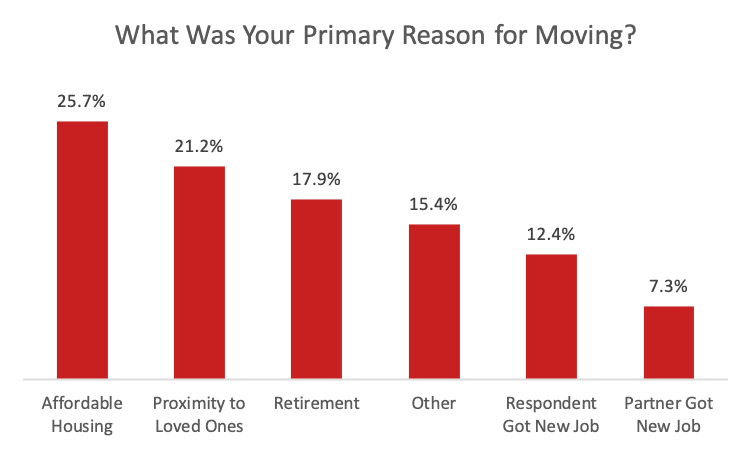
Survey respondents listed varying reasons for packing up their lives. The most common primary justification was more affordable housing (25.7%). In second place came proximity to family/partners (21.2%), followed by retirement (17.9%).

While only a quarter of participants move for affordability, almost 60% said their ability to afford non-housing expenses and leisure activities improved after their relocation.
About 1 in 7 respondents said they wouldn’t have been able to move without the ability to work remotely. Of people who moved specifically for affordability reasons, a slightly higher share said they couldn’t have relocated without remote work, indicating that remote work has enabled workers to move to areas with more affordable homes.
The most common metros respondents migrated away from for affordability reasons were the Bay Area, Los Angeles, and Seattle, while the most popular metros people moved to for affordability were Phoenix, Sacramento, CA and Portland, OR.
In the fourth quarter of 2019, 26% of Redfin.com home searchers looked to move to another metro area, up from 25% during the same period of the prior year, according to a Redfin report from February. That tied the all-time high for the national share of home-searchers looking to relocate that was set in the third quarter of 2019. Phoenix, Sacramento and Las Vegas saw the highest net inflows.
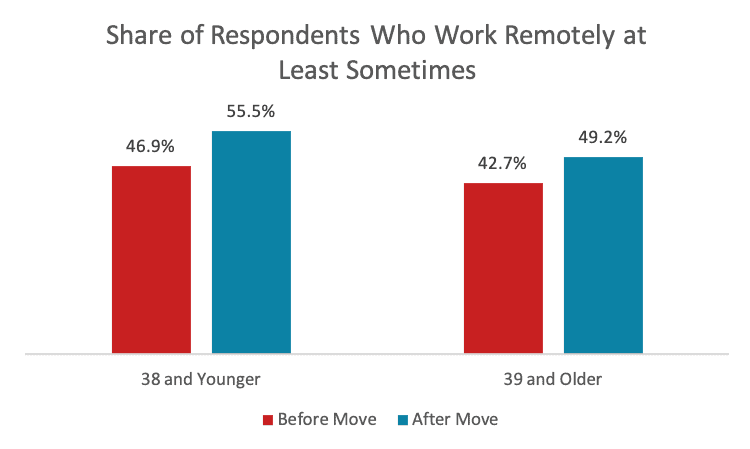
Among the survey respondents, younger people saw a greater increase in remote work after relocating than older people. Of participants 38 and younger, 55.5% worked remotely sometimes or always after moving, up from 46.9% before moving. Of participants 39 and older, 49.2% worked remotely sometimes or always after moving, compared with 42.7% before moving.

Methodology

Redfin conducted a survey in December 2019 of 272 U.S. residents who indicated that they either moved to a new metro area within the past year or have plans to do so within the next year. All respondents were asked about why they moved, where they moved to and from and how remote work played into their relocation. About 75% of people surveyed resided in Los Angeles, San Francisco, New York, Seattle or Boston.
For more information about the survey and its findings, contact press@redfin.com.

Posted by Consumers Relocation Services at 11:44 AM 1 comment:
Email ThisBlogThis!Share to XShare to FacebookShare to Pinterest

Monday, February 10, 2020

Assist Employees Moving Household Goods with Lump Sum Reimbursement Program (reprint)

Don’t let your relocating employees go it alone

In recent years many corporate transferees have been asked to take on a more active role in managing their own relocations. This trend developed with many new emerging companies that had not relocated people in the past and with larger more established companies whose relocation costs were steadily climbing; looking for ways to reduce this trend. At Consumers Relocation we see a tremendous number of people coming to us for assistance in their moves since their companies are asking them to manage many of the pieces of this process themselves.

Lump Sum Allowances Emerge
One of the largest trends has been the emergence of lump sum allowances for many of the typical relocation costs. Lump sum programs group a number of expense categories typical to relocation into on dollar allowance which the company will provide to the transferee. Househunting trips, temporary living expenses, miscellaneous expenses, final move expenses and shipment of household goods are the most typical expenses reimbursed under Lump sum programs. The most expensive of these categories is the actual shipment of household goods, and is probably the category where a transferee can save a considerable amount of money if done properly.

The attractiveness of lump sum programs to companies is the reduced administrative work in processing expense reports and audits. This reduced time allows human resource administrators more time to work with the relocating family in assisting them with school selection and other special needs. The HR administrator has more time to counsel transferees on current policy issues and to do other projects unrelated to relocation as well. Particularly for small and mid sized companies with understaffed HR departments, this program can provide that extra person that is needed.

Lump sum programs also provide more fiscal responsibility for relocation expenses on the part of the transferee. Transferees will take more time to spend their money wisely understanding that there is not an unlimited amount of dollars for their relocation. It allows them to spend more money on the activities that are the most important to them.

Lump sum programs reduce the costs of relocation in many cases; placing an absolute ceiling on relocation dollars. Lump sums will eliminate or drastically reduce the number of exceptions since the transferee has the latitude to spend dollars in activities that they formerly would have asked for as an exception.

Streamlined budgeting is a product of lump sum allowances. Programs eliminate the need for administrators to budget for each activity involved in the relocation process and make judgments on the overall program and apply factors to overall costs of relocation.

Many companies report improved employee satisfaction when lump sum programs are implemented. When companies disclose the details of the lump sum calculation, employees are less likely to challenge the costs of relocation. Generally the small percentage of employees that are not satisfied are thought to have been dissatisfied with the relocation process in general anyway.

Portions of Lump Sum Programs Need Active Management

Just as the corporate travel department arranging for airfares and hotels for the house hunting trip saves the transferee money and potential headaches, the shipment of their household goods can create pitfalls that are preventable through active management by experts. The transportation business in general, whether it be travel or shipping of household goods has its mysteries and obstacles that only knowledgeable experts can effectively navigate through. Pricing, timing, seasonality, delays, and a host of other variables are controllable and manageable by companies that specialize in these areas and the transferee should be offered their assistance in order to save money, time and improved satisfaction. Volume pricing may also be taken advantage in these areas as well; freeing up lump sum dollars to be spent in other categories.

When dealing with the shipment of household goods for interstate (state to state) moves, a variety of factors must be controlled because of the makeup of the business. In general the household goods industry can be considered regulated to a certain extent, however subject to market conditions in pricing, and also subject to local organizations for pricing and performance.

The household goods shipping industry is made up of large van lines that are essentially banking and dispatch organizations. Within each van line, are local agents that are for the most part independently owned and operated, and adhere to the guidelines of the overall van line for interstate shipments only. They operate under their own name and guidelines for local and intrastate (within the state) moves.

For interstate shipments, the local agent and their employees are responsible for the estimating of the cost of the move as well as the origin services such as packing, crating and other services that might be provided at origin. If a transferee is managing the move themselves, they must be careful in choosing this local agent and the van lines involved since the performance of local agents within the same van line may vary dramatically both in pricing accuracy and local services provided.

Most van lines have a variety of pricing plans available to their local agents. The type of pricing plan whether it be actual weight and services, guaranteed to not exceed, or fixed guarantee have applications in differing circumstances related to the move. The choice of plan must be done with much forethought in order to avoid a pricing plan that is counterproductive to the individual transferee’s move.

Van lines have several types of valuation coverage available to transferees and its important for them to understand these fully if they are managing their own move. Replacement valuation coverage may be purchased by an individual transferee with a variety of deductibles and can be expensive, but is necessary. Other valuation plans are available that look more attractive due to price, such a depreciated value plans, but will not adequately cover the damage of household goods in many cases. The industry standard, of sixty cents a pound, is offered at no charge to an individual transferee moving, but again is not adequate to cover significant damage. Move management companies like Consumers Relocation will offer the premium coverage, replacement valuation with no deductible, at no charge to either the transferee, or the client corporation.

Individual transferees managing their own move may become confused in the event of problems in the move or in the claims process if damage is experienced or if the shipment is delayed. Often times the person they dealt with at origin, the sales person, is not the person they will work with in the event of problems or claims. This confusion can cost the transferee many dollars in productivity and lost opportunity to recoup their loss. Experienced Move Managers are dealing with high volumes of moves with the van lines and have set up their own protocol of contacts to take care of the problems. Often times “gray area” problems can arise that an individual moving will not be able to sway in their direction. Move Managers, due to their volume of business, can equitably resolve ”gray area’” issues.

Companies that only work with a handful of transfers a year, may not be entirely familiar with the tariffs and pricing used in moving. These tariffs change periodically and some van lines file their own versions; complicating audits even further. Move Managers offer audit assistance with it be directly for your transferees or for the company. Mistakes can be made and sometimes the translation of promises made by the origin agent are not clearly communicated to the van line billing department. A Move Manager, involved in both the origin pricing and the final billing will quickly clear these kinds of issues up.

Companies offering lump sum reimbursements should encourage their transferees to obtain two to three estimates for their moves. Physical estimates are a must and phone estimates should be discouraged. Physical estimates create more accountability regarding pricing and the physical location of the home. When a mover actually sees what is being moved they can make a more accurate judgment as far as the weight of the shipment, packing services needed, crating needed, as well as the ability of the moving van to park close to the home; negating the need for the extra charge for a shuttle truck. An “apples to apples” comparison of the estimates can then be performed. A Move Manager can effectively order three estimates from reliable movers, and provide the comparisons, and resolving any unusual variances in weight, or services. The end result is the transferee can make an educated selection of mover with all the facts. Three estimates will also enable the transferee to have a better choice of load and delivery dates during busy time periods. One mover may not be able to accommodate the transferee’s dates, where one out of three will most likely be able accommodate the transferee.

Clearly, in certain relocation activities it is better for the transferee and the company to offer some managed benefits for relocation. Shipping household goods, real estate related activities and travel are the ones where the company and transferee benefit from working with reliable experts in these fields. Managing these activities will avoid the many dollar and service pitfalls a transferee may fall into.

Consumers Relocation Services manages household goods shipments for thousands of families each year. Volume discounts, special valuation coverage and personalized expert counseling one on one with each transferee is standard in the program. Consumers Relocation can save the company and transferee time and money on every move. Companies, large associations and real estate companies have been relying on Consumers Relocation since 1993 to deliver household goods move management services through out the United States and internationally as well.
Posted by Consumers Relocation Services at 6:45 AM 1 comment:
Email ThisBlogThis!Share to XShare to FacebookShare to Pinterest
Newer Posts Older Posts Home
Subscribe to: Posts (Atom)

Search This Blog

eNewsletter

Click here to view our monthly enewsletter filled with more helpful moving tips!

About Me

My photo
Consumers Relocation Services
View my complete profile

Get a Quote

Fill out our initiation form and we will contact you right away with up to 3 quotes.

Les Velte Twitter Updates

Twitter Updates

    follow me on Twitter

    Blog Archive

    • ▼  2023 (5)
      • ▼  April (3)
        • Preparing your houseplants for moving
        • Getting ready for your vehicle to be shipped
        • Real Life Move with a dishonest Moving Broker- sti...
      • ►  March (2)
    • ►  2022 (2)
      • ►  April (1)
      • ►  January (1)
    • ►  2021 (5)
      • ►  November (2)
      • ►  June (1)
      • ►  March (1)
      • ►  January (1)
    • ►  2020 (11)
      • ►  August (1)
      • ►  July (1)
      • ►  March (5)
      • ►  February (3)
      • ►  January (1)
    • ►  2019 (16)
      • ►  September (1)
      • ►  July (1)
      • ►  June (3)
      • ►  May (2)
      • ►  April (2)
      • ►  March (4)
      • ►  February (3)
    • ►  2018 (7)
      • ►  May (1)
      • ►  April (4)
      • ►  March (2)
    • ►  2016 (5)
      • ►  September (1)
      • ►  August (1)
      • ►  May (1)
      • ►  March (1)
      • ►  February (1)
    • ►  2015 (8)
      • ►  November (1)
      • ►  October (1)
      • ►  July (1)
      • ►  June (3)
      • ►  May (2)
    • ►  2014 (12)
      • ►  December (1)
      • ►  November (1)
      • ►  August (1)
      • ►  July (2)
      • ►  June (1)
      • ►  April (2)
      • ►  March (2)
      • ►  February (2)
    • ►  2013 (16)
      • ►  June (2)
      • ►  May (1)
      • ►  April (4)
      • ►  March (1)
      • ►  February (3)
      • ►  January (5)
    • ►  2012 (23)
      • ►  November (1)
      • ►  September (2)
      • ►  August (1)
      • ►  July (1)
      • ►  June (7)
      • ►  May (1)
      • ►  April (4)
      • ►  March (3)
      • ►  February (2)
      • ►  January (1)
    • ►  2011 (47)
      • ►  December (1)
      • ►  November (4)
      • ►  October (4)
      • ►  September (7)
      • ►  August (3)
      • ►  July (4)
      • ►  June (4)
      • ►  May (4)
      • ►  April (4)
      • ►  March (8)
      • ►  February (1)
      • ►  January (3)
    • ►  2010 (112)
      • ►  December (4)
      • ►  November (7)
      • ►  October (12)
      • ►  September (5)
      • ►  August (4)
      • ►  July (6)
      • ►  June (8)
      • ►  May (9)
      • ►  April (15)
      • ►  March (12)
      • ►  February (13)
      • ►  January (17)
    • ►  2009 (47)
      • ►  December (7)
      • ►  November (5)
      • ►  October (3)
      • ►  September (5)
      • ►  August (7)
      • ►  July (5)
      • ►  June (13)
      • ►  May (2)

    OnTopList

    Real-estate blogs
    Add blog to our blog directory. Consumers Relocation Services - OnToplist.com

    Blog Flux

    Blog Directory by Blog Flux

    TOPBLOGLIST

    Top Blogs

    TOPBLOGLIST

    Real Estate

    Blog Carnival

    Blog Carnival archive - moving and relocation information

    Blog Top Sites

    Real Estate Blogs

    BC

    Real Estate Investment & Advice Blogs - BlogCatalog Blog Directory
     

    Twenty Fives Years!

    Twenty Fives Years!

    Subscribe To

    Posts
    Atom
    Posts
    All Comments
    Atom
    All Comments